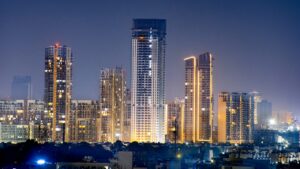
In a city located in Seismic Zone IV, the biggest question is this: Are our buildings truly earthquake-resistant, or only compliant on paper?
Gurugram. One of India’s fastest-growing cities, Gurugram is now filled with towering high-rise buildings, multi-storey apartments, and densely packed builder floors. But amid this rapid development, a serious public-safety question remains unanswered—if a major earthquake strikes, will these buildings actually be as safe as they appear on paper?
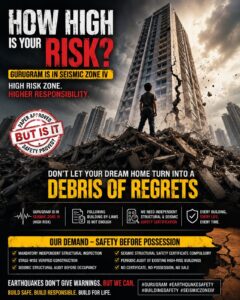
Gurugram has been classified as Seismic Zone IV. The Haryana Building Code also requires building designs to comply with the National Building Code and relevant BIS standards, including standards for earthquake-resistant structures, and provides for structural-safety certification.
But the real question is not whether the design was approved on paper; it is whether the construction on the ground matches that design.
Was the foundation built according to the approved structural design?
Was the specified quantity and quality of reinforcement used?
Were the columns, beams, slabs, and shear walls constructed in accordance with the seismic design?
And most importantly—who independently and effectively inspected these critical structural stages during construction?
A certificate from an architect or structural engineer alone cannot fully answer whether what was approved was actually built.
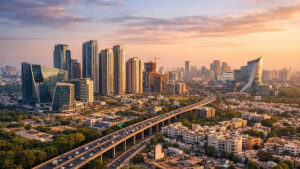
Haryana’s regulations provide for third-party structural-safety certification in certain cases. But in a rapidly expanding high-rise city like Gurugram, the need goes further: there must be a system for independent verification of critical structural stages so that a building’s seismic safety does not depend solely on documentation.
Therefore, the question for the government and the relevant agencies in Gurugram is this—
Can an independent structural and seismic safety audit be arranged for every existing high-rise building?
And instead of waiting until after a major earthquake to determine which buildings were safe and which were not, shouldn’t these buildings be independently inspected today?
Because after an earthquake, relief and rescue will certainly be necessary.
But true disaster management is ensuring, before an earthquake strikes, that people’s homes do not become their graves.
The question is not merely how tall a building is — the question is how safe it is.